MICROOPERATION:
- Basic operation executed on data stored in the resistors
- Elementary operation performed by information in resistor
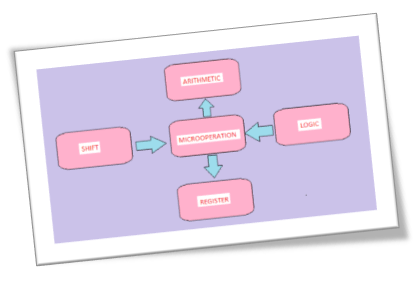
ARITHMETIC MICROOPERATION:
- Arithmetic operations on numeric data stored in registers
- Performs the arithmetic or mathematical operation with information in resistor.
| Symbolic Designation | Description |
| R3 ← R1 + R2 | Contents of R1+R2 transferred to R3. |
| R3 ← R1 – R2 | Contents of R1-R2 transferred to R3. |
| R2 ← (R2)’ | Compliment the contents of R2. |
| R2 ← (R2)’ + 1 | 2’s compliment the contents of R2. |
| R3 ← R1 + (R2)’ + 1 | R1 + the 2’s compliment of R2 (subtraction). |
| R1 ← R1 + 1 | Increment the contents of R1 by 1. |
| R1 ← R1 – 1 | Decrement the contents of R1 by 1. |
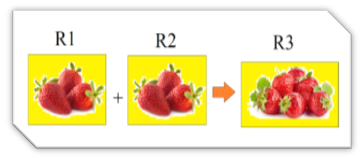
Addition-
- the data in 2 resistors are added and stored in another resistor
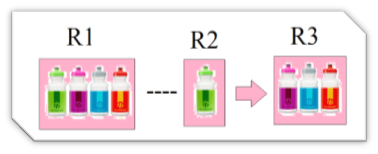
- R3=>R1+R2
- The above statementinstructs the data or contents of register R1 to be added to data or content ofregister R2 and the sum should be transferred to register R3.
Subtraction-
- the difference of 2 resistors is stored in a resistor
- In subtract micro-operation, instead of using minus operator we take 1’s compliment and add 1 to the register which gets subtracted, i.e R1 – R2 is equivalent to R3 → R1 + R2′ + 1
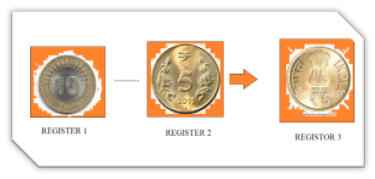
- Increment and decrement micro-operations are generally performed by adding and subtracting 1 to and from the register respectively.
- Increment -the content of resistor is added with 1 and stored in another resistor
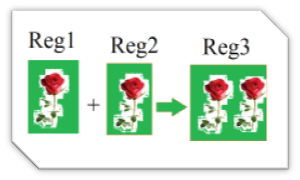
- Decrement -the content of resistor is subtracted 1 and stored in another resistor
REGISTER TRANSFER MICROOPERATION:
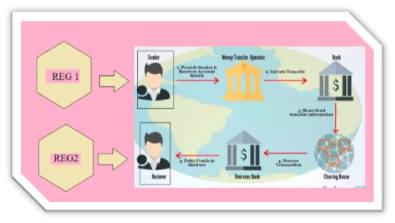
- Transfer binary information from one register toanother.
- Information transferred from one register to another isdesignated in symbolic form by means of replacement operator(- Registertransfer language.
- Accumulator: -common register-usedto store data taken out from the memory.
- General PurposeRegisters: -used to store data intermediate results during program execution. -It can be accessed via assembly programming.
- Special PurposeRegisters: Users do not access these registers. These registers are for Computersystem,
- MAR: Memory AddressRegister – registers that holds the address for memory unit.
- MBR: Memory BufferRegister- stores instruction and data received from the memory and sent fromthe memory.
- PC: Program Counter-points to the next instruction to be executed.
- IR: InstructionRegister- holds the instruction to be executed.
- the transfer of the data from register R1 into R2.
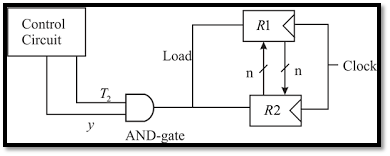
- we want the transferto occur only in predetermined control condition. This can be shown by following if-then statement:if (P=1) then (R2 ← R1)
- Here
Pisa control signal generated in the control section
.
Control Function
- A control function is a Boolean variable that is equal to 1 or 0. The control function is shown as:
- P: R2 ← R1
- The control condition is terminated with a colon. It shows that transfer operation can be executed only if P=1.

LOGIC MICROOPERATION:
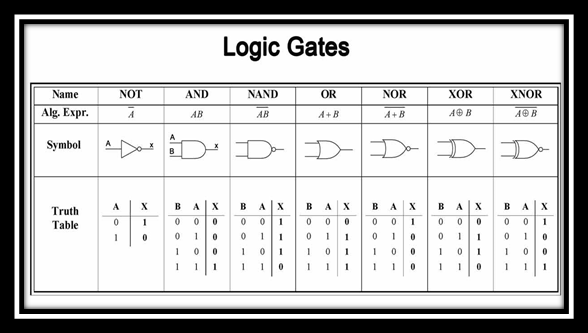
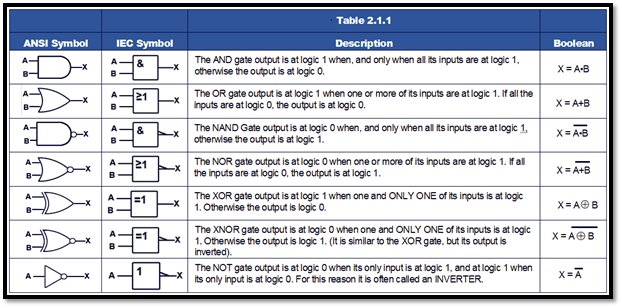
- Bit manipulation operation on non-numeric data stored in registers.
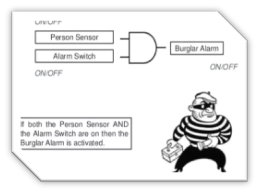
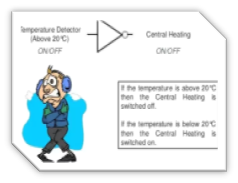
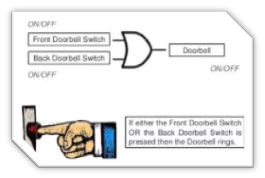
BASIC GATE EXAMPLES
AND
NOT
OR
SHIFT MICROOPERATION:
- Serialtransfer of data
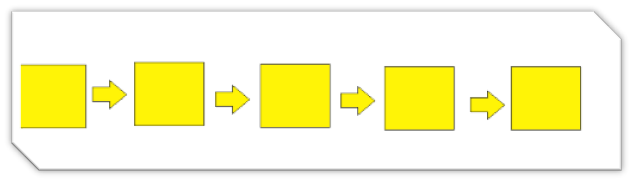
- shift micro-operations performed on data.
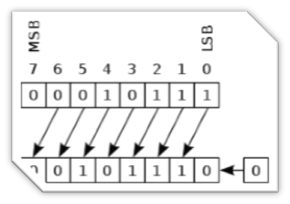
- shift left operation- the serial input transfers a bit to the right mostposition
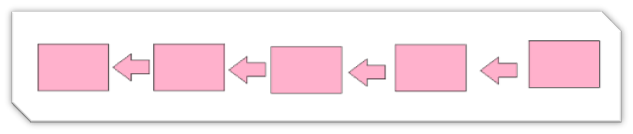
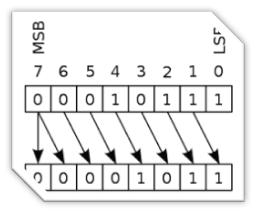
- shift right operation- the serial input transfers a bit to the leftmost position.
a) Logical Shift(luggage transfer)
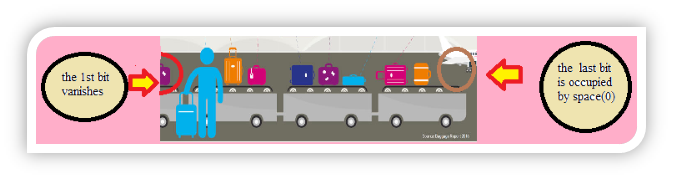
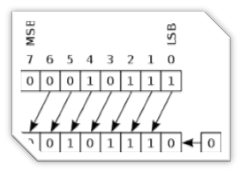
It transfers 0 through the serial input. The symbol “shl” is used for logical shift left and “shr” is used for logical shift right.
R1 ← she R1
R1 ← she R1
The register symbol must be same on both sides of arrows.
b) Circular Shift(EXAMPLE -TIME)
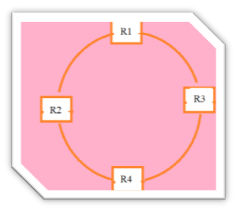
This circulates or rotates the bits of register around the two endswithout any loss of data or contents.

In this, the serial output of the shift register is connectedto its serial input. “cil” and “cir” isused for circular shift left and right respectively.

c) Arithmetic Shift
This shifts a signed binary number to left or right. An arithmetic shift left multiplies a signed binary number by 2 and shift left divides the number by 2.
Arithmetic shift micro-operationleaves the sign bit unchanged because the signed number remains same when it ismultiplied or divided by 2.
.

 COMPUTER ARCHITECTURE